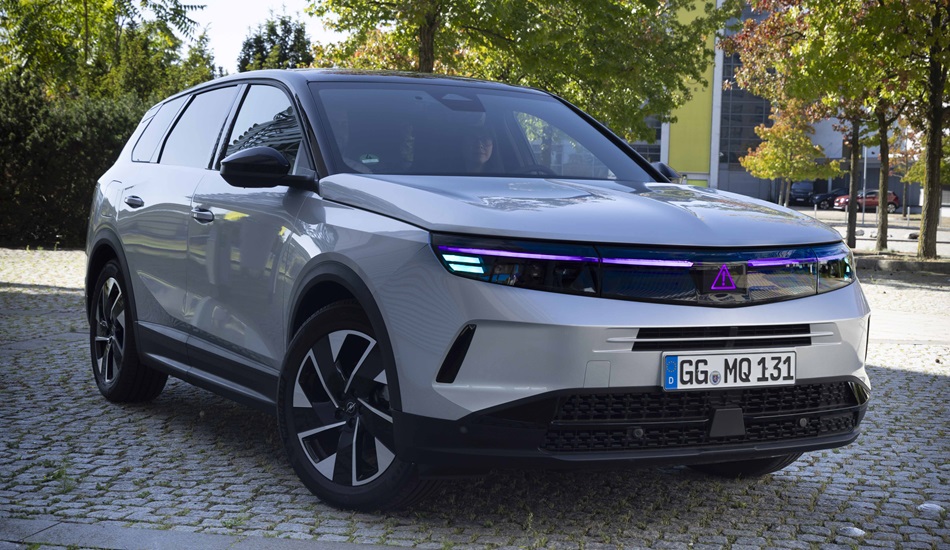
The German manufacturer Opel, a historical leader in automotive lighting technology, has introduced Artificial Intelligence (AI)-supported lighting communication systems designed for use in future autonomous vehicles. Opel, Stellantis, and the Technical University of Darmstadt (TU Darmstadt) presented a specially prepared Opel Grandland at the International Automotive Lighting Symposium (ISAL) in Darmstadt. The test vehicle demonstrated how SAE Level 3 autonomous vehicles (hands-off, eyes-free) could communicate with other road users via their lighting systems in the future.
The German automaker Opel continues to maintain its pioneering role in lighting technologies. At the International Automotive Lighting Symposium (ISAL) in Darmstadt, Opel, Stellantis, and the Technical University of Darmstadt (TU Darmstadt) showcased a specially developed Opel Grandland demonstration vehicle. The test car demonstrated how future autonomous vehicles, possessing SAE Level 3 capabilities (hands-off, eyes-free), could communicate with other road users via their lighting systems.

Providing pioneering lighting technologies to customers is a deep-rooted tradition at Opel. In line with this understanding, lighting innovations featured on various Opel models with the “Blitz Logo” include:
- Intelli-LED: Available on Corsa and Mokka models.
- Intelli-Lux Matrix: Available on Corsa, Mokka, and Combo models.
- Intelli-Lux Pixel Light: Featured on Astra models.
- Intelli-Lux HD Light: Available on the Grandland model.
Opel’s innovations in lighting technology aim not only to improve visibility but also to create safer and smarter interactions on the road. At the International Automotive Lighting Symposium in Darmstadt, Philipp Röckl, Global Lighting Director at Stellantis, and Julisa Le, Director of Innovation Engineering, presented a forward-looking concept revealing how autonomous vehicles can communicate with pedestrians and other road users through light. To realize this vision, the team collaborated with the Opel Concept Workshop and students from TU Darmstadt to develop the specialized Opel Grandland demonstration vehicle.
Philipp Röckl, Global Lighting Director at Stellantis, explained: “While headlights clearly play a crucial role in enhancing road safety, modern lighting systems can do much more. For example, lighting signatures can be easily animated and used for communication. Furthermore, the illuminated ‘Blitz Logo’ on the Grandland can be replaced with a screen that can display the emblem while also being used to communicate with other road users and pedestrians. By utilizing existing lighting elements, we can easily integrate communication functions as we add autonomous driving features to our vehicles.”
Lighting Systems Meet Artificial Intelligence (AI)
To demonstrate what future vehicles might be capable of, the Opel team first identified potential use scenarios. These included scenarios of “possible danger from a pedestrian or another situation” and “the situation becoming safe, with the danger posed by the pedestrian being eliminated.” Simply put, these scenarios represented situations most drivers encounter in daily life, such as a child chasing a ball into the road or a pedestrian suddenly emerging from between two parked cars. Considering these situations, the team integrated both a camera system capable of detecting objects and movements, and an AI-supported algorithm that can predict intentions, into the Grandland test vehicle. They then began developing the lighting technologies to support these systems.
When operating in SAE Level 3 or higher mode, the Grandland signals its status clearly to other road users by continuously illuminating its front and rear indicators in cyan color. Other signature lighting elements remain in their usual white.
When the camera systems detect a pedestrian in front of the vehicle, the signature lighting turns magenta, and the screen displays a warning signal in the same color. This visually alerts the pedestrian that the vehicle is approaching, and the car begins to slow down. After the Grandland stops, the signature lighting turns green, and the screen displays the “walking green figure” seen on pedestrian crossing lights. This indicates that the vehicle has recognized the danger, has stopped, and the pedestrian can now cross safely. In situations where the AI algorithm cannot manage the situation, the system prompts the driver to take control of the vehicle. This structure is fully compatible with industry standards regarding ADAS protocols.
Julisa Le, Director of Innovation Engineering at Stellantis, commented: “We chose colors that are specifically not associated with other vehicle functions to avoid misunderstandings. For example, while red is intuitively a warning color, it is used for brake lights and rear lights. Cyan and magenta were meticulously evaluated for perception and are currently not used in any traffic situation. Both colors ensure clear and understandable communication with other road users.”
This innovation reflects Opel‘s commitment to developing accessible and intelligent safety solutions for all road users, while also contributing to increased trust in autonomous vehicles.
Opel, Stellantis, and TU Darmstadt began joint research on new lighting technologies in 2022. This collaboration is implemented as part of Stellantis’s global research network with the world’s leading universities. In these laboratories, called “OpenLabs,” scientific knowledge is generated for innovative technology systems to be used in future vehicles. This strategic partnership with TU Darmstadt opens the door to a new era in lighting technologies, with Stellantis also providing scholarship support to three PhD students at the university’s Department of Electrical Engineering and Information Technology.